Masks and duplicity
The DoubleMasks and duplicity names a recurring tension in Yakov Petrovitch Golyadkin’s account of himself: he insists that he acts openly while suspecting that other people conceal their intentions. The mask becomes both a literal image for social performance and a measure of his increasingly precarious grasp on how others see him. He rejects daily pretence, yet repeatedly adjusts his conduct to an audience; as his public standing collapses and a double appears, his distinction between his own honest self and other people’s duplicity grows harder to sustain.
Golyadkin’s Distinction Between Open Conduct and Social Performance
Speaking to Krestyan Ivanovitch Rutenspitz, Golyadkin presents himself as a quiet, unpolished man who has not mastered the social arts. He describes a world in which people are expected to impress others, make polished compliments, and “polish the floor with one's boots.” He says he has not learned these practices and does not regret it. His speech frames social ease as performance, but also shows that he understands the expectations he claims to reject. He can name the gestures and verbal skills required to win approval, even as he declares himself unsuited to them.
Golyadkin makes that self-presentation more explicit when he tells the doctor that he does not intrigue or act secretly. He claims to disdain indirect methods and to be disgusted by slander and duplicity; the mask, he says, belongs at a masquerade, not in everyday dealings. He then asks how the doctor would take revenge on a worst enemy. The juxtaposition unsettles his declaration of plain dealing: while insisting on openness, he introduces the possibility of retaliation and watches the doctor anxiously for a response. Krestyan Ivanovitch does not engage with the speech as Golyadkin intends, instead saying that he does not understand and turning to prepare a prescription. The gap between Golyadkin’s carefully emphatic explanation and the doctor’s practical response establishes how little control he has over the interpretation of his performance.
The Mask as a Social Theory
In a later conversation with Anton Antonovitch, Golyadkin expands his personal defense into a theory about society. He argues that people who wear masks are increasingly common and that it has become difficult to recognize the person beneath one. When Anton asks whether this is really so difficult, Golyadkin clarifies that he means both literal masks at carnival or festive gatherings and a less obvious concealment in ordinary life. The distinction lets him describe duplicity without directly naming a particular culprit, but Anton declines to pursue the argument, saying that he has no time and that Golyadkin’s business will be explained in due course.
At the office, Golyadkin also addresses clerks as if his position were a lesson in character. He says that people may refuse to treat social polish as life’s highest calling, to claim happiness just because their clothes fit, or to fawn and intrude where they are unwelcome. He presents himself as one of those people and says he has nearly explained himself, then tries to withdraw. The clerks laugh, and Golyadkin leaves with an offended appeal to the future. The scene turns his account of unmasked sincerity into another public performance: he wants the clerks to recognize his principles, but their laughter denies him the audience and standing he seeks.
Public Encounters and the Failure of Self-Presentation
The contrast between Golyadkin’s professed indifference to display and his attention to appearances is visible from the start of the evidence. After dressing in newish clothes and admiring his boots, he rides along Nevsky Prospect in a hired carriage. He initially chuckles as if pleased with a successful performance, then becomes anxious and scrutinizes passers-by, adopting a sedate air whenever he thinks he is being watched. At the turn from Liteyny Street, he hides when he sees two clerks from his department. When Andrey Filippovitch, the head of his office, recognizes him from a passing droshky, Golyadkin cannot conceal himself and blushes. His public appearance is something he both stages and fears being seen in.
At Olsufy Ivanovitch’s gathering, that tension becomes a humiliating breakdown. Golyadkin moves through the crowd, damages a lady’s dress, collides with people, and finds himself facing Klara Olsufyevna. Though he tries to begin with congratulations and good wishes, he stammers, blushes, and loses his composure under the guests’ silence and laughter. He appeals to Andrey Filippovitch that the matter concerns his private life rather than official business; Andrey rebukes him and turns away with Klara. Golyadkin protests that he has nothing to be ashamed of, but the crowd offers no support. He tries to recover by retreating to a corner and behaving like a modest, detached spectator, then invents an explanation for why he is guarding two chairs. The effort to pass as properly placed only makes the audience’s scrutiny more conspicuous.
The pattern recurs at the office, where Golyadkin approaches colleagues to greet them and conciliate them. Some answer curtly, others avoid him, and younger clerks gather around with insulting curiosity. When his double joins the group, smiling and nimble, the attempt to manage the encounter through ordinary courtesy has already failed. Later, at a restaurant, Golyadkin reads a letter and becomes so agitated that he walks up and down gesturing, apparently addressing the air. The other diners watch him with suspicion. He then notices that his clothes are disordered and muddy, with his coat torn and his right trouser strap damaged. His claim to present himself as “all right” is repeatedly contradicted by what others can see, while he remains uncertain about how he has come to appear before them.
The Double and the Uncertain Face Beneath the Mask
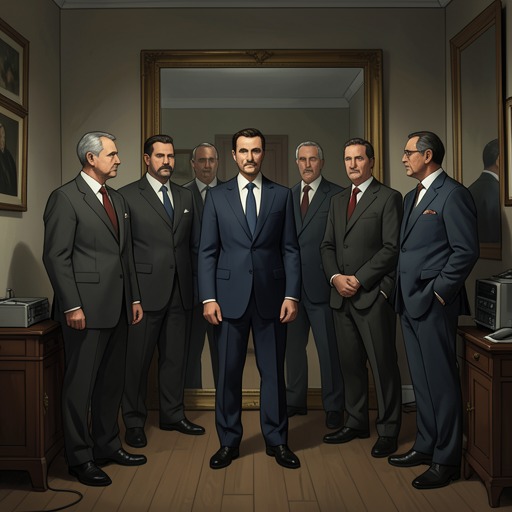
The double gives the mask motif its sharpest form. When Golyadkin sees the newcomer seated opposite him in the office, he recognizes him as the figure who had been his terror and shame the night before. The newcomer is described as matching Golyadkin in height, build, clothes, and baldness, to the point that an observer could not distinguish the original from the copy. Yet the colleagues show no surprise. Their silence troubles Golyadkin as much as the double’s appearance: the event seems to him uncanny, but the surrounding office continues as though nothing unusual has occurred.
That difference between what Golyadkin experiences and what he can establish publicly sharpens the ambiguity of his theory. He suspects masks in everyday life, yet the evidence also shows him interpreting other people’s reactions through anxious conjecture. During his flight from the gathering in the November storm, the humiliation occupies him so completely that he loses a golosh without noticing. At the Fontanka railing, he suddenly feels that someone is beside him and has said something private, although he sees no one. These moments do not prove that his suspicions are correct; instead, they place the reader close to his distressed perceptions while leaving their status uncertain. The double, likewise, is presented through Golyadkin’s terror even as the office treats him as an ordinary newcomer.
Recognition, Misrecognition, and the Motif’s Significance
At the final gathering, Golyadkin is led before Olsufy Ivanovitch expecting a direct reckoning over the intercepted letter. Instead, Olsufy receives him warmly without offering his hand. Golyadkin reads the older man’s grave expression as goodwill, and imagines that Klara, Vladimir Semyonovitch, and Andrey Filippovitch share a tearful sympathy. The narration immediately qualifies this impression: the tears and collective compassion may be Golyadkin’s fancy, intensified by his own emotion. His sense of reconciliation is real to him, but the scene does not confirm that everyone else sees the moment in the same way.
The recurring mask is therefore more than a symbol of deliberate deceit. It organizes Golyadkin’s effort to distinguish a truthful self from a world he experiences as staged, hostile, and unreadable. He condemns social fawning but tries to control how he looks; he claims to speak plainly but explains himself through insinuation and elaborate self-defense; he searches for concealed motives even where the narrative marks his interpretation as uncertain. The identical double makes the central problem visible: resemblance no longer guarantees a secure distinction between original and copy, while the reactions of others offer him no reliable confirmation. By the ending, even his perception of sympathy may be a mask laid over uncertainty, and the motif has become inseparable from the question of whether Golyadkin can recognize himself through other people’s faces.